
| Core Metric | Thrissur District Details |
|---|---|
| Geographical Location / Status | Central Keralam district; part of Keralam’s cultural, administrative, coastal, and midland region |
| District Headquarters | Thrissur |
| Total Land Area in sq km | 3,032 sq km |
| Population as per latest available Census data | 31,21,200 as per Census 2011 |
| Literacy Rate | 95.08% as per Census 2011 |
| Number of Rivers / Major Rivers | Major rivers include Bharathapuzha, Kecheri River, Karuvannur River, and Chalakudy River |
| Revenue Divisions | 2 — Thrissur and Irinjalakuda |
| Taluks | Thrissur, Mukundapuram, Kodungallur, Chavakkad, Thalappilly, Chalakudy, Kunnamkulam |
| Municipalities | Chalakudy, Chavakkad, Guruvayoor, Irinjalakuda, Kodungallur, Kunnamkulam, Wadakkanchery |
| Number of Grama Panchayats | 86 |
| Assembly Constituencies | Chelakkara, Kunnamkulam, Guruvayoor, Manalur, Wadakkanchery, Ollur, Thrissur, Nattika, Kaipamangalam, Irinjalakuda, Puthukkad, Chalakudy, Kodungallur |
| Lok Sabha Constituency / Constituencies | Thrissur, Chalakudy, Alathur |
| Official District Website | thrissur.nic.in |
What Makes Thrissur Unique?
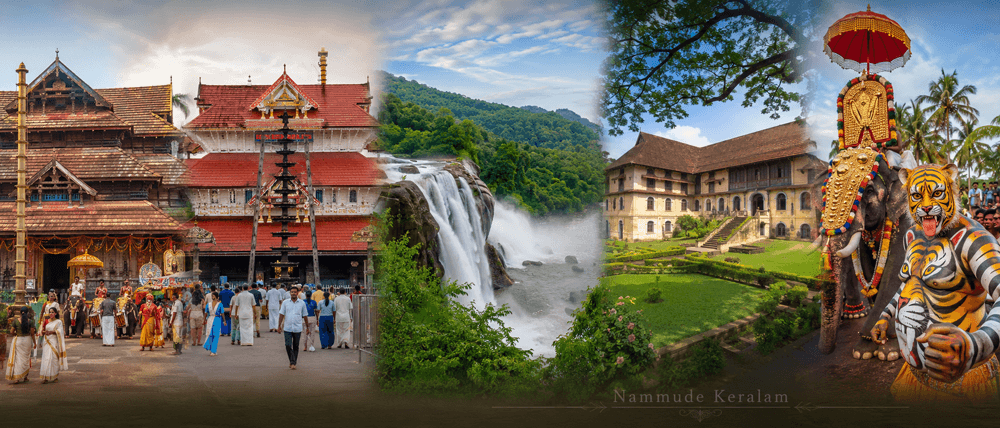
Thrissur district is widely known as the cultural capital of Keralam.
Its identity comes from temples, festivals, art institutions, heritage towns, coastal settlements, and river-based landscapes.
Thrissur city grew around Thekkinkadu Maidan and Vadakkunnathan Temple. This central urban form gives the city a distinct civic and cultural identity.
Thrissur Pooram is the district’s best-known public festival. It is associated with Vadakkunnathan Temple and Thekkinkadu Maidan.
The district has strong links with Keralam’s performing arts. Kathakali, Koothu, Koodiyattam, percussion traditions, temple arts, and folk forms have a visible presence here.
Thrissur Keralam is also important for religious and social heritage. Guruvayur is one of Keralam’s most visited temple towns. Kodungallur has deep historical importance in Keralam’s coastal and trade history. Irinjalakuda is known for Koodalmanikyam Temple.
The district has coastal, midland, and eastern highland features. Chavakkad and Kodungallur connect the district to the Arabian Sea coast. Athirappilly and Vazhachal connect Thrissur to the Western Ghats landscape.
Thrissur district also has a strong service economy. Banking, gold trade, education, health care, retail, agriculture, tourism, and small industries shape local livelihoods.
Malayalam is the main language. English and Hindi are also used in education, tourism, trade, and public services.
Geography and Administrative Profile
Thrissur district is located in central Keralam.
It lies between the northern and southern regions of the state. This makes it important for road, rail, trade, education, tourism, and public administration.
Thrissur shares boundaries with Palakkad, Malappuram, Ernakulam, and Idukki districts. The western side connects to the Arabian Sea coast through coastal areas such as Chavakkad and Kodungallur.
The district has varied terrain.
It includes coastal plains, backwater-linked areas, midland settlements, agricultural zones, river valleys, and forested eastern highlands.
Major rivers include Bharathapuzha, Kecheri River, Karuvannur River, and Chalakudy River. The Chalakudy River is closely linked with Athirappilly and Vazhachal waterfalls.
Important natural and landscape features include:
Athirappilly waterfall region
Vazhachal forest landscape
Chimmini wildlife and dam area
Peechi-Vazhani region
Chavakkad coastal belt
Chettuva backwater area
Kole wetlands and paddy fields
Revenue Divisions
Thrissur district administration is divided into two revenue divisions:
Thrissur Revenue Division
Irinjalakuda Revenue Division
These divisions support land administration, revenue services, disaster management, certificates, and public grievance functions.
Thrissur Taluks
The main Thrissur taluks are:
Thrissur
Mukundapuram
Kodungallur
Chavakkad
Thalappilly
Chalakudy
Kunnamkulam
Taluk offices are important for land records, revenue certificates, mutation support, caste certificates, income certificates, and local administrative services.
Thrissur Municipalities
Thrissur district has one municipal corporation and seven municipalities.
The municipal corporation is:
Thrissur Municipal Corporation
The Thrissur municipalities are:
Chalakudy Municipality
Chavakkad Municipality
Guruvayoor Municipality
Irinjalakuda Municipality
Kodungallur Municipality
Kunnamkulam Municipality
Wadakkanchery Municipality
These urban local bodies manage civic services, local roads, building permissions, waste management, public health functions, and local taxation.
Panchayat Structure
Thrissur district has 86 grama panchayats.
It also has block panchayats and district panchayat-level local self-government institutions.
The panchayat system is important for rural roads, drinking water, local welfare schemes, agriculture support, health outreach, sanitation, and local development planning.
Major Towns and Urban Centers
Major towns and urban centers in Thrissur district include:
Thrissur
Guruvayur
Chalakudy
Irinjalakuda
Kodungallur
Kunnamkulam
Chavakkad
Wadakkanchery
Cherpu
Mala
Kodakara
Anthikad
These towns support education, trade, tourism, transport, health care, and citizen services.
Major Places to Know in Thrissur
Vadakkunnathan Temple
Location: Thrissur city, near Thekkinkadu Maidan.
Why it is important: It is one of the most important heritage and religious landmarks in Thrissur.
Claim to fame: Thrissur Pooram is associated with the temple premises and Thekkinkadu Maidan.
Vadakkunnathan Temple is central to the identity of Thrissur city. The temple and surrounding maidan form a major cultural and civic anchor.
Guruvayur Temple
Location: Guruvayur, near Chavakkad.
Why it is important: Guruvayur is one of Keralam’s most prominent temple towns.
Claim to fame: Guruvayur is a major pilgrimage destination in Keralam.
The town supports a large religious, hospitality, transport, and service economy. It is one of the best-known places in Thrissur district.
Athirappilly Waterfalls
Location: Athirappilly, near Chalakudy.
Why it is important: It is the best-known waterfall destination in Thrissur district.
Claim to fame: Athirappilly is widely recognized as Keralam’s largest waterfall.
Athirappilly lies on the Chalakudy River near the entrance to the Sholayar forest ranges. It is also linked with Vazhachal and the eastern forest landscape.
Shakthan Thampuran Palace
Location: Thrissur city.
Why it is important: It is a major historical landmark connected with the royal and administrative history of Thrissur.
Claim to fame: The palace is named after Shakthan Thampuran, who shaped the development of Thrissur town.
The palace is an important heritage site for students, tourists, and local history researchers. It helps explain Thrissur’s urban and cultural development.
Kodungallur
Location: Coastal south-western side of Thrissur district.
Why it is important: Kodungallur has deep historical, coastal, religious, and trade significance.
Claim to fame: It is associated with some of Keralam’s oldest coastal heritage traditions.
Kodungallur is important for understanding Keralam’s maritime history and religious diversity. It also connects Thrissur district with the coastal economy.
Citizen Services and Local Infrastructure in Thrissur
Administrative Centers
Thrissur district administration is centered around the District Collectorate in Thrissur.
Important administrative centers include:
District Collectorate, Thrissur
Revenue Divisional Office, Thrissur
Revenue Divisional Office, Irinjalakuda
Taluk offices in Thrissur, Mukundapuram, Kodungallur, Chavakkad, Thalappilly, Chalakudy, and Kunnamkulam
Thrissur Municipal Corporation office
Municipal offices in Chalakudy, Chavakkad, Guruvayoor, Irinjalakuda, Kodungallur, Kunnamkulam, and Wadakkanchery
District Panchayat office
Block panchayat offices
Grama panchayat offices
District Police Office, Thrissur
District and Sessions Court, Thrissur
These offices support land records, public grievances, law and order, certificates, local development, welfare schemes, and court-related services.
Health Infrastructure
Thrissur district has major public and private health facilities.
Important public health institutions include:
Government Medical College, Thrissur, Mulankunnathukavu
General Hospital, Thrissur
District-level public health institutions
Taluk hospitals
Community health centres
Primary health centres
Family health centres
Government Medical College, Thrissur is a major referral institution. It serves Thrissur and nearby districts.
General Hospital Thrissur is an important public hospital for urban and district-level health services.
Public health services in Thrissur citizen services include immunisation, outpatient care, emergency care, maternal health, disease control, palliative care, and local health outreach.
Education Infrastructure
Thrissur district is an important education center in Keralam.
Major educational institutions include:
Keralam Agricultural University, Vellanikkara
Government Engineering College, Thrissur
Government Medical College, Thrissur
Keralam Kalamandalam, Cheruthuruthy
Keralam Institute of Local Administration, Mulankunnathukavu
Government colleges and aided colleges across the district
Professional colleges in engineering, medicine, nursing, pharmacy, arts, science, commerce, and teacher education
Thrissur is also known for cultural education. Keralam Kalamandalam is especially important for classical art forms.
The district supports students from central Keralam and nearby districts.
Transport Infrastructure
Thrissur has strong road and rail connectivity.
Major railway stations include:
Thrissur Railway Station
Guruvayur Railway Station
Chalakudy Railway Station
Irinjalakuda Railway Station
Wadakkanchery Railway Station
Punkunnam Railway Station
Major bus transport centers include:
Thrissur KSRTC Bus Station
Sakthan Thampuran Bus Stand
North Bus Stand, Thrissur
Guruvayur bus station
Chalakudy bus station
Kodungallur bus station
Irinjalakuda bus station
Kunnamkulam bus station
Major highway corridors include:
NH 544 through the Thrissur–Chalakudy corridor
NH 66 through the coastal side of the district
Important state highways linking Thrissur with Guruvayur, Kodungallur, Irinjalakuda, Kunnamkulam, Wadakkanchery, and Palakkad-side routes
Thrissur district does not have a major commercial airport inside the district.
The nearest major airport is Cochin International Airport at Nedumbassery in Ernakulam district. It serves domestic and international passengers from Thrissur.
Water-linked local areas include Chettuva backwaters and coastal zones near Chavakkad and Kodungallur. These areas are locally important for fisheries, tourism, and water-based livelihoods.
Economy and Local Livelihoods
Thrissur district has a mixed economy.
It includes agriculture, trade, services, tourism, health care, education, religious tourism, banking, jewellery, small industries, and coastal livelihoods.
Agriculture
Agriculture remains important in rural Thrissur.
Key agricultural activities include paddy cultivation, coconut, banana, vegetables, tubers, and mixed homestead farming.
The Kole wetlands are important for paddy cultivation and wetland ecology. They also support birdlife and seasonal farming patterns.
Trade and Services
Thrissur city is a major service and trade center.
Gold trade, textiles, retail, banking, finance, education, and health services are important sectors.
The district has long been associated with cooperative banking, private finance, jewellery business, and urban trade networks.
Tourism and Pilgrimage Economy
Tourism supports hotels, transport, guides, restaurants, small shops, festival services, and local employment.
Guruvayur supports a major pilgrimage economy.
Thrissur Pooram supports seasonal tourism and local commerce.
Athirappilly, Vazhachal, Peechi, Chimmini, Snehatheeram Beach, and heritage sites support nature and heritage tourism.
Fisheries and Coastal Livelihoods
Coastal areas such as Chavakkad, Kodungallur, and nearby fishing settlements support fisheries and related livelihoods.
Marine fishing, inland fishing, fish markets, boat-related work, and processing activities are important for local families.
Small Industries and Local Production
Thrissur district has small-scale industries, workshops, food processing units, furniture units, printing, metal works, and trade-linked enterprises.
Traditional sectors also remain visible in some areas.
These include handloom-linked activity, crafts, temple art services, percussion-related craft, and local food production.
Remittance and Employment
Like many Keralam districts, Thrissur has a strong connection with overseas employment and domestic migration.
Remittances support housing, education, retail, real estate, and local services.
Culture, Language, and Society
Malayalam is the main language of Thrissur district.
English is common in education, administration, tourism, and professional services. Hindi and Tamil are also used by migrant workers, tourists, and traders.
Thrissur has a strong cultural identity.
Major traditions include:
Thrissur Pooram
Pulikali during Onam season
Temple percussion traditions
Kathakali
Koodiyattam
Koothu
Folk arts
Classical music and dance traditions
The district has important cultural institutions.
Keralam Kalamandalam at Cheruthuruthy is one of Keralam’s most important institutions for classical performing arts.
Thrissur city is also associated with cultural academies, literature, visual arts, and theatre.
Religious and social heritage is diverse.
The district has major temples, churches, mosques, and historic religious sites. Guruvayur, Vadakkunnathan Temple, Kodungallur, Irinjalakuda, and Christian heritage centers are part of this identity.
Food habits are typical of central Keralam.
Rice, coconut, fish, vegetables, banana-based dishes, snacks, vegetarian temple food, and festival meals are common. Coastal areas have stronger fish-based food traditions.
Local lifestyle varies by region.
Urban Thrissur is service-oriented and trade-driven. Rural areas combine agriculture, remittance-supported households, small business, and local public services. Coastal areas retain fishing and maritime-linked livelihoods.
Thrissur District Administration and Local Information Summary
Thrissur district administration is important for central Keralam.
The district connects cultural heritage, citizen services, tourism, agriculture, health care, education, and trade.
Thrissur at a glance can be understood through five key points:
It is Keralam’s cultural capital.
It has 7 taluks and 2 revenue divisions.
It has 1 municipal corporation and 7 municipalities.
It has major tourism anchors such as Guruvayur and Athirappilly.
It is a major service, education, health, trade, and pilgrimage district.
For citizens, Thrissur local information is useful for land services, public health, education, transport, courts, police, panchayat services, and municipal services.
For tourists, Thrissur tourist places include temple towns, waterfalls, beaches, forests, palaces, and festival locations.
For students and researchers, Thrissur Keralam offers strong cultural, historical, agricultural, administrative, and ecological study value.
Suggested Official Sources to Verify
Official District Administration Website
Keralam Government Portal
Keralam Tourism
Census of India
Local Self Government Department, Keralam
Keralam Legislative Assembly
Chief Electoral Officer, Keralam
Election Commission of India
District Court Thrissur
Government Medical College, Thrissur
Keralam Agricultural University
Frequently Asked Questions About Thrissur
What are the taluks in Thrissur district?
The taluks in Thrissur district are Thrissur, Mukundapuram, Kodungallur, Chavakkad, Thalappilly, Chalakudy, and Kunnamkulam.
What is Thrissur district famous for?
Thrissur district is famous for its cultural identity, Thrissur Pooram, Vadakkunnathan Temple, Guruvayur Temple, Keralam Kalamandalam, Athirappilly Waterfalls, temple arts, percussion traditions, heritage towns, and its role as a major service and trade center in central Keralam.
Which are the major tourist places in Thrissur?
Major tourist places in Thrissur include Vadakkunnathan Temple, Guruvayur Temple, Athirappilly Waterfalls, Vazhachal, Shakthan Thampuran Palace, Kodungallur, Peechi Dam, Chimmini Wildlife Sanctuary, Snehatheeram Beach, and Keralam Kalamandalam.